 Codex
Codex





Multi-day builds
- Goals persist across restarts
- Criteria define what done means
- Pick up where the agent left off
Bind the goal once.
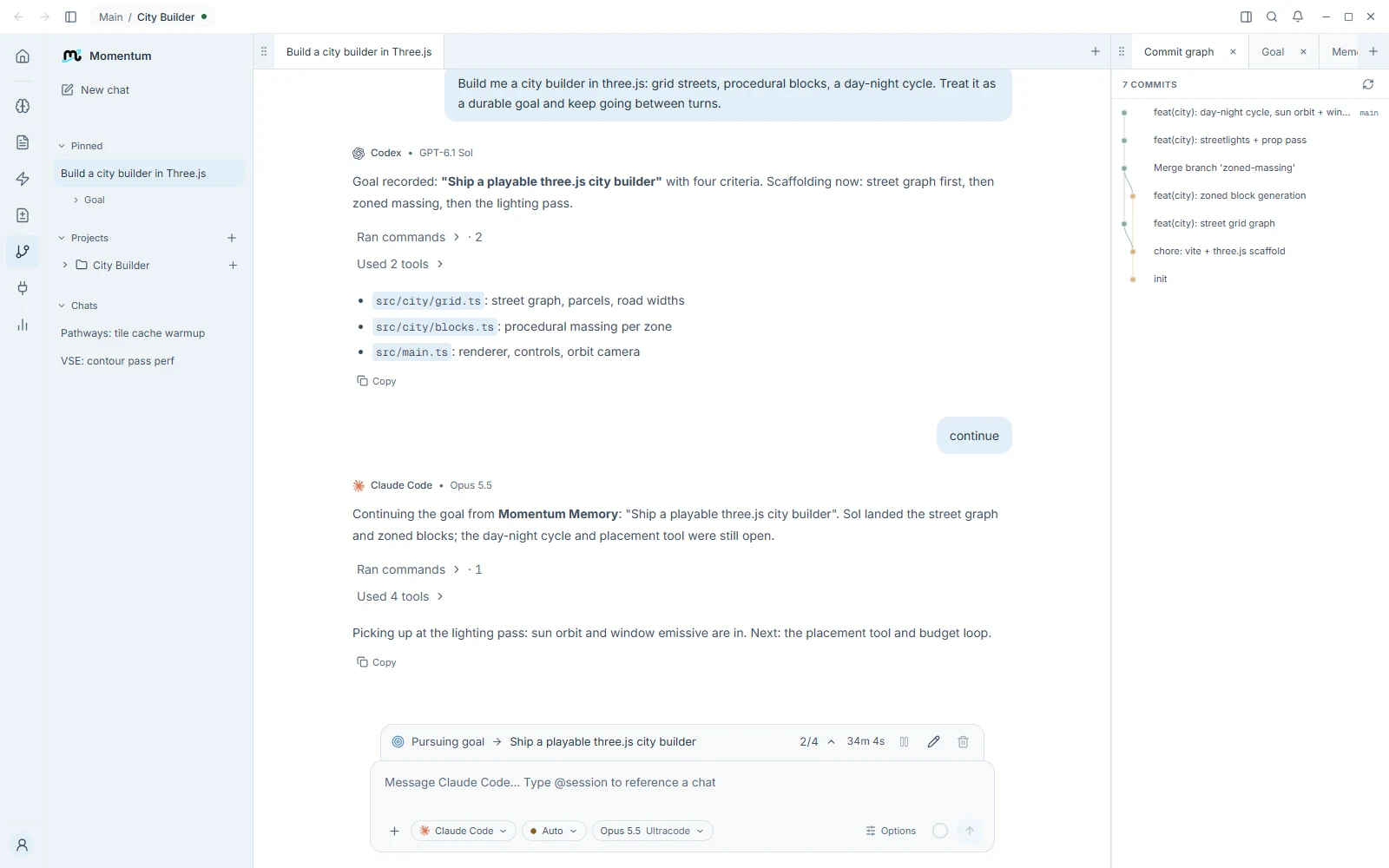
“Build a city builder in three.js” becomes a durable goal: title, criteria, constraints, bound to the session, not the runtime. Codex runs it at GPT-6.1 Sol, Ultra effort, Approve for me.
“Build a city builder in three.js” becomes a durable goal: title, criteria, constraints, bound to the session, not the runtime. Codex runs it at GPT-6.1 Sol, Ultra effort, Approve for me.
Sol scaffolds the street graph and zoned blocks. Every file it touches shows up in Review as it lands: staged, edited, untracked.
Real commits on real branches: the work is a tree you can inspect, not a transcript you have to trust.
New runtime: Claude Code, Opus 5.5, Auto mode, Ultracode effort. Type “continue” and nothing else; the goal comes back from Momentum Memory.
Receipts record which harness ran, how the turn ended, and what it changed, across the handoff too.
All four criteria pass, the goal flips to met, and the preview fills the whole frame.
The goal binds to the session itself: swap the harness or the model mid-flight.
Connect it with your agents via MCP&ACP.2
Goals, memory, and checkpoints live in a local store you control. We don't process or retain any of it on our end.
Harnesses like Claude Code or Codex talk to their own model providers. That traffic is between you and the provider under their terms.
Local archive-and-resume infrastructure for agents: versioned goals, typed memory, and atomic SQLite checkpoints, so work continues after disconnects, restarts, or a full context window.
Momentum scans the machine for installed harnesses (Codex, Claude Code, Grok Build, and other ACP-compatible runtimes) and connects locally, binding continuity to the session itself.
Goals, memory, and checkpoints live in a local store you control. We do not process or retain any of it on our end.
Momentum Cloud (a self-hosted enterprise console) and Momentum Enterprise (priority support and fleet licensing) are coming soon and not generally available.
 Claude Code